
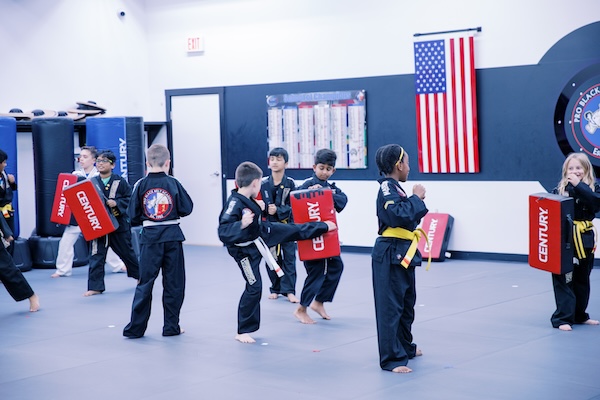
A lot of martial arts schools focus on one discipline and go deep. There's value in that. But at Pro Black Belt Academy McKinney, we've built our curriculum around four systems: Taekwondo, American Karate, Jiu-Jitsu, and Kickboxing. That's not a marketing decision. It's what Master Buddy Hudson concluded after 40+ years of training, competing, and teaching: the most capable students are the ones who don't have gaps.
Here's what each discipline adds and why the combination works.
Taekwondo
Taekwondo is the technical foundation of everything we teach. It's a precision art. The emphasis on controlled, powerful striking technique, structured belt progression, and disciplined movement creates habits that carry into every other martial art. For younger students especially, the clear progression system gives them something concrete to work toward. Every belt earned reflects a real skill milestone, not just time spent in class.
Taekwondo also develops exceptional balance, coordination, and lower-body power. Students who train seriously in Taekwondo move differently than people who don't. That physical awareness shows up in every sport and activity they pursue.
American Karate
Where Taekwondo emphasizes precision, American Karate adds power. The chamber-and-drive mechanics of Karate train students to generate force from their whole body, not just their limbs. That principle transfers directly into every other technique they learn. Karate also broadens the striking toolkit beyond kicks, developing upper body technique, footwork, and the ability to switch between ranges quickly.
Master Buddy Hudson holds a 9th Degree Black Belt in both Taekwondo and American Karate. The combination is central to the PBBA curriculum and always has been.
Jiu-Jitsu
Jiu-Jitsu answers a question that striking arts alone can't: what happens when someone takes you to the ground? In real-world situations, altercations go to the ground more often than most people expect. Ground work, control positions, and submission techniques give students practical options they would otherwise be completely unprepared for. For kids, Jiu-Jitsu also builds spatial awareness and the ability to manage physical pressure calmly, which is genuinely useful outside the dojo.
Kickboxing
Kickboxing is where conditioning and timing come together. The combination work, footwork patterns, and cardio demands of kickboxing training push students in ways that technical drilling alone doesn't. It also develops combination fluency, the ability to chain techniques together naturally rather than executing them one at a time. Students who train kickboxing hit harder, move more fluidly, and last longer under pressure.
Why the Blend Produces Better Martial Artists
A student who only trains one style has predictable gaps. A student trained in all four has options. The PBBA curriculum integrates these systems deliberately, each discipline reinforcing the others rather than competing with them. Taekwondo precision makes Karate more accurate. Karate power makes Taekwondo kicks harder to ignore. Kickboxing conditioning makes everything last longer. Jiu-Jitsu closes the ground gap that every striker eventually has to face.
At PBBA McKinney, the goal is to produce complete martial artists: students who can strike, defend, and move with confidence in any situation. That's the standard Master Buddy Hudson built this curriculum around, and it's what we bring to the mat every day. Come try a free intro class and see it for yourself.